
books · Mystery

Book Review: Miracle Creek by Angie Kim

Oops, I did it again. I got overly excited about a book with rave reviews, a book that’s absolutely blowing up online and on social media, and I got a little let down. Miracle Creek has been #1 on my TBR list for awhile and I’m a little bummed that I wasn’t totally into it. However, there are a lot of redeeming qualities to this book and I did enjoy it! Just maybe not as much as I hoped.

The story follows a family of immigrants from Seoul and a few other key characters as they navigate the aftermath of an explosion and a subsequent murder trial. The Paks own “Miracle Submarine,” a hyperbaric oxygen chamber that is used to treat a variety of medical conditions, including the symptoms of autism, cerebral palsy, and infertility.

Although some consider the oxygen treatment to be “quack” medicine, the Paks are excited to finally be living their American dream and hoping for the success of the future.

The author of the novel, Angie Kim, does an excellent job telling the story from multiple point of views. This writing technique upped the mystery and enticed the reader to understand how the crime possibly could have been committed by multiple characters in the novel. Each POV showed the motivations of a different character. 

Kim’s overarching and triumphant rhetoric on motherhood throughout the story is overwhelmingly troubling, but it’s also raw and shows a masterful understanding of the complexities of being a mother. She taps into the varying emotions of love, unquestioning devotion, but also the moments of weakness that motherhood forces one to confront: pain, hatred, and the occasional desire to be free of the tether of having a child.

Elizabeth’s story, however troubling, elucidates an ever-shamed aspect of motherhood. Her story brings the question of what constitutes abuse to the forefront. In today’s cultural climate, one that simultaneously shames women for breastfeeding but also hinders the rights of women to conceive, raise and treat their children, this story line was eyeopening and necessary.

Elizabeth, the mother of an autistic child, Henry, is accused of his murder. Without physical evidence, the prosecution resorts to attacking the way she has cared for his child over the course of his life. She’s subjected him to alternative therapies for his autism, treatment after treatment, to try to perfect his focus, his speech, his attention to detail, and his behavior itself. Her near-obsessive desire to “fix” Henry becomes the sole argument, the most damning evidence against her – deemed as “unnecessary” and overkill. Henry was getting better, why was she trying to make him perfect?

Elizabeth’s inner debate is fascinating. She questions herself. The conversation stemming from Elizabeth’s plight makes for great food for thought. Although some of the other characters fell a bit flat for me, I thought Kim’s personification of “the mother” through multiple characterizations showed how motherhood is different for everyone, there is no right way to parent, and those that force their opinion on other parents are often doing more harm than good.

Beach Reads · books · Thriller · Thriller

Review: The Silent Patient by Alex Michaelides

the silent patient - alex michaelides thriller NYT bestseller

Just like any typical 20 -something I seem to be drawn to psychological thrillers these days. Not to brag, but I can usually see all of the “unexpected plot twists” coming from a mile away. I am also notorious for predicting the ending of a movie 10 minutes in and whispering to my boyfriend “she did it”, which he is obviously really fond of.  I started reading The Silent Patient by Alex Michaelides with the expectation that I would be able to use my amazing skills to see the ending coming early on. However, I am pleasantly surprised to report that this was not the case.

 The Silent Patient is the story of a psychotherapist, Theo Faber, who takes a job at a high security psychiatric hospital in the hopes of triggering a breakthrough in one of the most notorious patients there, a woman who shot her husband five times without any known motive. Alicia Berenson has not spoken one word since she was charged with the murder of her husband. She is a well known local artist and her last attempt at communication was a self portrait entitled Alcestis.  To provide some background Alcestis is a lesser known Greek play in which the Queen Alcestis volunteers to die in the place of her husband Admetus. She was rescued by Hercules and brought back to life. Alcestis is the epitome of a selfless woman/wife in the setting of ancient Greece. Alex Michaelides uses Alcestis to help build Alicia Berenson’s character and to set the stage for the events leading to her husband’s death.

Theo Faber has a personal history of mental illness. He uses his experience with depression, child abuse and PTSD to help foster meaningful bonds with his patients. He is determined to help Alicia come to terms with her crime and speak out about what happened to her. As the novel unfolds we slowly learn that Theo has some unresolved issues of his own that still haunt him, and that he relates to Alicia’s situation on a very personal level.

The author does an excellent job at periodically introducing less significant characters that may or may not have played a role in the crime. This led to numerous moments where I thought I had figured it all out- but alas, I must admit I did not accurately predict this one.

books · Mystery

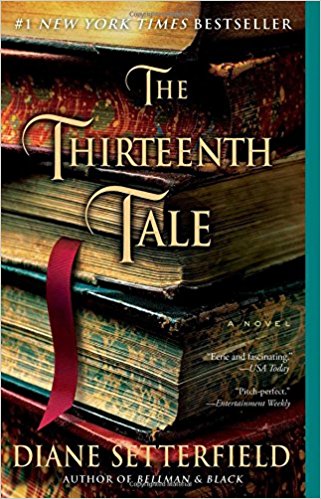
Review: The Thirteenth Tale by Diane Setterfield

I was in a bit of reading slump lately. Everything that I had been picking up was very slow. I was perusing Amazon for new releases when I stumbled on The Thirteenth Tale. Once I realized that Once Upon a River, another novel by Setterfield I’ve been hearing a lot about, won’t be released until the summer, I lost myself in the author bio and took a look at some of Setterfield’s past work. The Thirteenth Tale stood out.

This book was as eerie as described and even more unsettling than I anticipated. Margaret Lea, the daughter of a a bookshop owner, is called upon, unprompted, by famed author Vida Winter to write the legend’s biography.

Vida Winter is notorious for lying to reporters and making up outlandish stories about her past. She has not told (or faced) the truth about her life ever before, but now chooses Margaret to write the truth.

One of my biggest issues with the book was that Ms. Winter seemed way too comfortable with Margaret. For someone who had kept her life a complete secret, she is all too prepared to tell this absolute stranger her full story, without any reasoning for why. In my opinion, Vida’s justification for why she hired Margaret doesn’t explain her comfort with her. I would have expected a closeted person to have more walls up. Still, Vida Winter is a complex and satisfying character. She is a storyteller, and she is determined to make sure she remains as such, even as she is narrating the story of her own life.

Margaret is a far less exciting character. She is the daughter of a bookshop owner (a personal dream) and yet she is somehow able to make even that seem boring. She’s never read a Vida Winter book, but is called upon to bring her character to life, the only known record of the writer’s life. She wouldn’t be my first choice.

Vida Winter reveals her secrets (and some that are not hers to tell) to Margaret. Their developing friendship is heartwarming – one gets the sense neither of them has ever had a true friend.

The underlying theme of the novel is identity. Both characters struggle with it, and not in the traditional “finding yourself” way you see in most novels. Both women are twins. There is A LOT of twin symbolism in this book. Typically I find the twin/psychic telepathy theme to be overplayed, but the layers of originality in the story are too good to be mistaken for poor thematic writing.

Margaret was born with a twin, but she died after a surgery was performed to separate their connected torsos. She has lived the rest of her life with the incessant feeling that there is a piece of herself missing – a feeling that leaves her largely depressed and not all that much of an asset to society. She feels guilt at surviving. She feels lost for surviving. This faceted idea of identity resonated with me. As someone who is largely independent, and yet still has the tug of directions when making decisions, I can’t imagine the feeling of having a missing piece of myself that I feel an allegiance to, an ever-nagging shadow.

The identity crisis goes much further. It’s deep and surprising and gives the book a mysterious, gothic quality.

The crossover between Gothic and Realism is a winner. Diane Setterfield s a great storyteller and I think this is a quality read for those looking for a mystery that isn’t just based in modern-missing-girl-true-crime (looking at you, Girl on the Train). If you want a mystery with edge, a complex story, ghostly hauntings, and good writing – read this!