
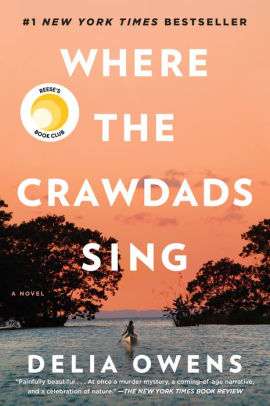
Where the Crawdads Sing by Delia Owens has become a bit of a phenomenon. If you haven’t noticed, rave reviews of the novel are popping up everywhere, and not without good reason. As a reader, and in other facets of my day-to-day life, I tend to not give in to the hype. Rather, I try desperately to resist the hyped-up books, TV shows, and trends, until I eventually give in and admit I was wrong about not believing the hype all along.
Crawdads was on my list, but it was bumped to the top when my Dad chose it for our family book club. The decision was made for me, and I’m glad.
Kya Clark is the “Marsh Girl.” Abandoned by her parents at a young age, one a battered wife, one a drunk, she grows up in a shack on the North Carolina swamp, raising herself beside the gulls and the shellfish.
Kya lives a lonesome existence. The story ebbs and flows like the tides of the marsh, ushering loneliness forth with the tide. The story conveys the state of isolation as reprehensible, and yet the most natural state of being.
Desperate to learn, Kya is taught to read by a local boy, Tate Walker. Tate is a wholesome, selfless character who serves the purpose of loving and caring for Kya above all else. Even when he makes mistakes, Tate is immediately regretful and willing to devote himself completely to making Kya trust him again.
One issue I have with the character development is Tate’s Christ-like goodness. He’s just too good. Conversely, Kya is extremely untrusting, unwilling to ask for or accept help. Neither is a believable character, TBH.
Humans are social beings, born out of connection and bred for it. With a lack of socialization, Kya’s development parallels the marsh more so than it does her peers in the village. Kya and the marsh are symbiotic. It feeds her, teaches hers to grow and mature in her biology. In turn, she takes care of the gulls, feeds them, nurtures them like her friends. Kya’s love for the marsh is both endearing and heartbreaking.
“Needing people ended in hurt.” Kya learns this as a child of the marsh, and as she grows, she doubles down on this belief. It may be unfortunate, but Kya’s experience teaches her that love disappoints. And hurts. She just does not want to give in to that hurt, which I commend.
The masses are voraciously claiming this book to be fantastic. I say, it’s a great story. I found the ending to be satisfactory based on the distant way Kya developed throughout. Her character comes full circle in the sunset of the novel in a way that I found to be refreshingly true to the character.
 2 Book Girls