
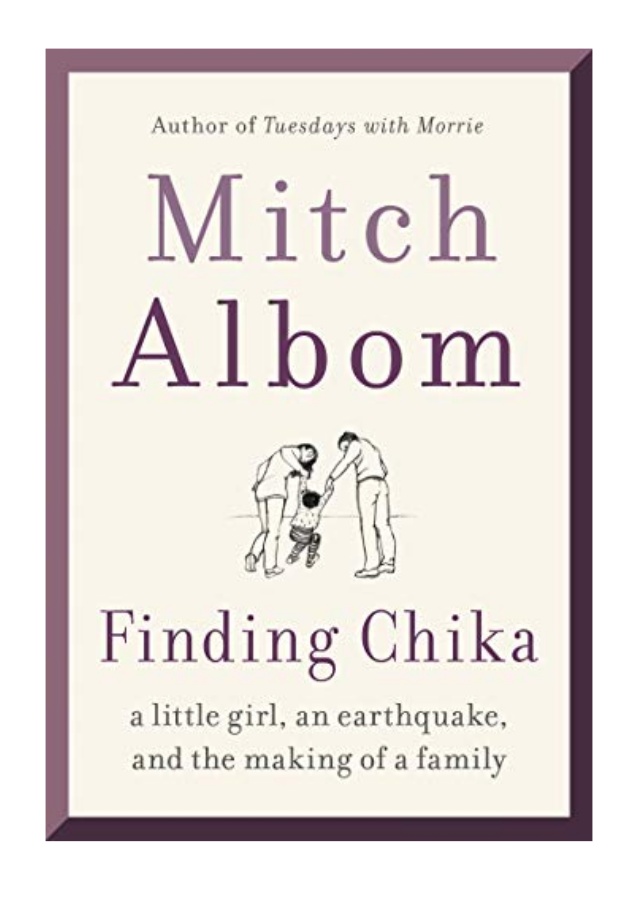
It’s not every day that a book like Finding Chika comes across your lap, and firstly, I’d like to thank Mitch Albom for his tireless efforts to capture the human experience in ways that are so often indescribable. Albom, a longtime author and journalist, also happens to be a philanthropist, funding and operating an orphanage in Haiti. It was at that orphanage, the Have Faith Haiti Orphanage, that Albom met Chika Jeune. Chika was born just before the devastating earthquake that rocked Haiti in 2010, but unfortunately for Chika, the earthquake was the least of her troubles
Chika, a smart and spunky young girl with a big attitude, starts to show signs of illness at the orphanage. One of her eyes doesn’t remain fully open and she walks with a slight limp. After bringing Chika to a neurologist in Haiti, she is deferred for diagnosis in the United States. Albom and his wife Janine take her in, starting their almost two-year journey as her legal guardians.
Chika is diagnosed with DIPG, or diffuse intrinsic pontine glioma, a tumor located in the middle of the brain stem. As such, the tumor is inoperable. It cannot be removed fully without harming critical parts of her brain. At the moment of diagnosis, before his relationship with Chika has even begun to develop, Albom writes, “Anyone who has sat through that slice of time, when you don’t know something awful and then you do, will confirm that it is literally a bend in your life, and what is critical is what you choose next; because you can view a diagnosis many ways – as a curse, a challenge, a resignation, a test from God.”
Albom perseveres against viewing the diagnosis as a curse. So begins a long journey of experimental treatment, success, and failure to treat Chika. And all through it, Mister Mitch and Miss Janine are there.
Watching Albom navigate parenthood as an older man is the most heartwarming and then heartbreaking aspect of this memoir. The reader falls in love with Chika. She is a delight – innocent, pure of faith, devoted to her family. But Albom’s description of her as the catalyst for turning him into a man and making him a father is undoubtedly the sweetest. Albom also describes how his wife takes to motherhood, how it changes his attraction to her, makes him fall in love with her even more. This little girl truly changed their marriage, evolving it and making it stronger for knowing her. Without knowing her power, Chika turns two successful, happy, thriving adults into a family, and give them a purpose beyond themselves that is unfairly taken from them.
Chika may not understand what Albom does for work in a broad sense (“Do you have to go to work today, Mister Mitch – Do you have to write a book?”), but she explains his job as this: “Your job is to carry me!” Albom translates that into a lesson that permeates the entire narrative – “What we carry defines who we are. And the effort we make is our legacy.” Choose your burden, follow that path, and commit to the effort it may take to succeed because that defines meaning and purpose.
Mitch Albom is an expert storyteller. This is a tearjerker, but the tears are more than worth getting to know Chika, a brave little soul.
 As much as I love the podcast My Favorite Murder, I didn’t have high expectations for their debut book, Stay Sexy & Don’t Get Murdered. The podcast with a cult following is entertaining as hell, and I’ve been following Karen Kilgariff and Georgia Hardstark for some time now and although I love their podcast and hearing from them every week, I was very hesitant to get excited about this book. Boy was I wrong.
 2 Book Girls