
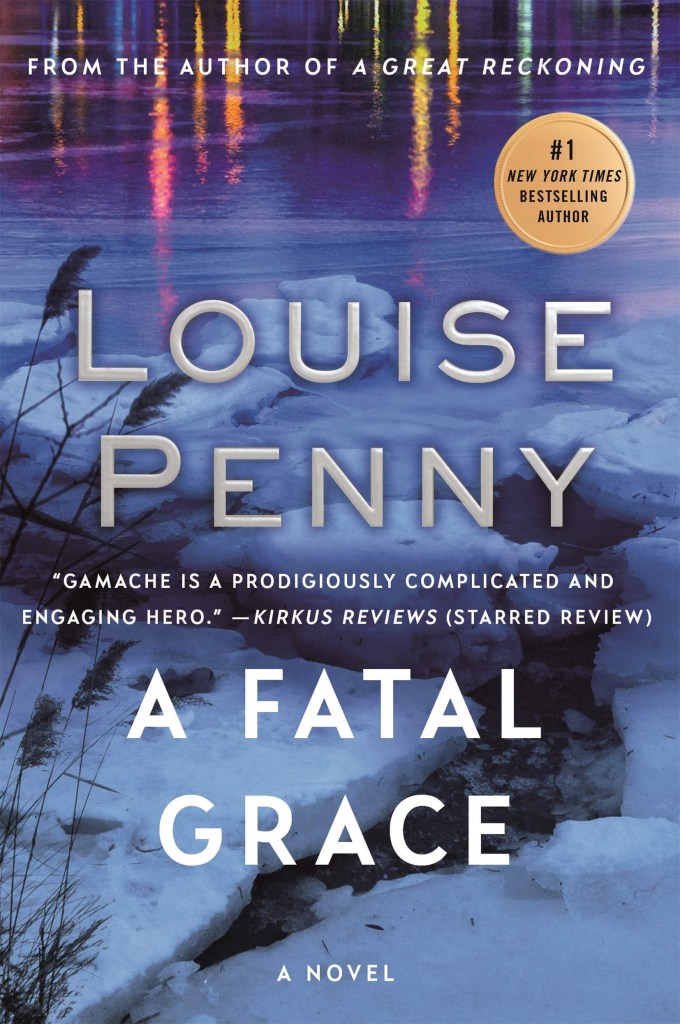
A Fatal Grace is the second novel in the Chief Inspector Gamache series by Louise Penny. Popular with the bookstagram community and in online circles, Louise Penny is well-known for her penchant for the murder mystery. She’s been creating the world of Gamache since 2005 with the publication of Still Life.
Still Life finds Chief Inspector Armand Gamache called to Three Pines to investigate the murder of an older woman, Jane Neal. A Fatal Grace brings the reader back to Three Pines for another investigation, this time of a middle-aged woman universally disliked, CC des Poitiers.
Penny’s newest novel in the series was released in late 2019 and having heard good things about it, I was interested in starting the series from the beginning. Now, after finishing the sophomore book in the series, I feel more apt to comment on the story and the characters themselves. The series has now fully lured me in with its rich descriptions of land, folk, and lore.
Initially I was concerned about Penny’s return to Three Pines. There are a fair few books in the series, and I kept thinking about the actuality that so many murders would occurin a sleepy, small town like Three Pines. I was wary that the series would begin to seem unbelievable. But comforted by my familiarity with the characters and the backdrop, I fell quickly into A Fatal Grace and didn’t look back.
Many of the characters from Still Life resurface in the novel, including Clara and Peter Morrow, local artists who were close to the murdered Jane Neal. There are also a number of familiar faces in the owners of the local bistro, Olivier and Gabri, and the retired poet that Gamache so admires, Ruth Zardo.
Aside from my concerns that there wouldn’t actually be so many murders in a small town like this, my other concern about believability was brought to light in the happenstance way that Gamache conducts his investigations. He ingrains himself in the politics of the town, getting to know each person and what makes them tick. He tells a young detective Robert Lemieux, “You need to know this. Everything makes sense. Everything. We just don’t know how yet. You have to see through the murderer’s eyes. That’s the trick, Agent Lemieux, and that’s why not everyone’s cut out for homicide. You need to know that it seemed like a good idea, a reasonable action, to the person who did it…No, Agent Lemieux, our job is to find the sense.”
Of course, this notion of knowing that the crime makes sense, and trusting that it does, propel Gamache to be the talented investigator that he is. But his methods are somewhat unorthodox. I find that his friendships with the members of the town are so close, that he offers information to could-be killers. He is often found at the bistro talking casually to someone that the reader later finds out has a major motive. I wondered why a lot of these conversations weren’t taking place in police headquarters, or atleast being recorded. It almost seems that Gamache’s utmost trust in the world “making sense” also makes him somewhat naïve. This naiveté may end up becoming a weakness.
CC des Poitiers is an awful human – rude, self-obsessed, and undeserving of any remorse. Still, Gamache must investigate who decided her life would be cut short. CC is electrocuted in a near impossible murder. She is killed while watching a curling match, her un-gloved hand on a metal chair which has been connected to a generator. She is standing in a puddle, and her shoes have metal on them. All of these would have to be known by the murderer in order to kill her. Gamche sets to work, investigating her husband, her daughter, and various others in the town. As he investigates though, he comes upon another murder in Montreal and is faced with the reality that the cases may not be unrelated. I am thoroughly enjoying the Chief Inspector Gamache series and I’m looking forward to reading more from Louise Penny.

 2 Book Girls