
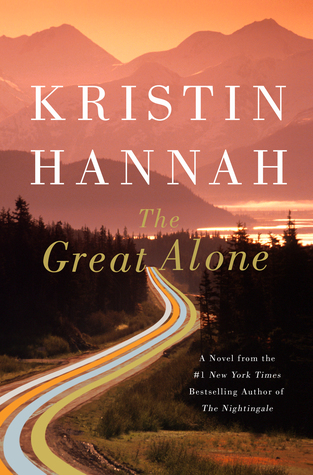
Having just finished The Great Alone by Kristin Hannah, I am still trying to dissect my feelings on the novel. Currently, I feel…unsettled.
A coming of age novel about a young girl in the 1970s, Leni Allbright is the daughter of a Vietnam War POW, Ernt Allbright, and his wife Cora. Ernt has just returned home to his wife and daughter, but he’s not the same man who left. The war has transformed Ernt, and not for the better. He is out of money and out of options, having been fired from numerous mechanic jobs.
Ernt has decided to move his family to Alaska, to a small peninsula where a fellow Vietnam soldier has left him a plot of land. Big dreams about the unknown formulate as the Allbright family considers how Alaska could be the answer to their prolonged search for happiness.
While summer in Alaska brings days of unending sunlight and the promise of freedom, the Alaskan winter quickly sets in to foil any hope the Allbrights had for that happiness. Ernt’s moods are unpredictable with the winter weather, and the family is unprepared for harsh Alaskan weather.
Banding together to help the Allbrights prepare, even as Ernt protests outside help, the Kaneq community proves to be a steadying force in Leni’s life. Made up of a motley crew of native Alaskans and those newer to Alaska, the community dynamic was one of my favorite parts of the novel. There’s an understanding of true kindness and goodness that permeates the personal boundaries between neighbors. Alaska may be The Great Alone in many ways, but there is always a helping hand for Leni and Cora when they need it. Their problem is learning how to accept help.
Leni thrives in the wilderness. Ernt teaches his wife and daughter to prepare for the end of the world, which is helpful in the Alaskan wilderness, but it doesn’t protect them from him. Ernt’s dark moods are sudden and he has an insistence that “holier-than-thou” men are trying to destroy Kaneq with money and materialism. Nothing will stop him fom aggressively beating his wife.
Truly, this book gave me a lot of anxiety. Cora and Leni live in a world of fear, constantly afraid of what will set Ernt off and end in bruises for Cora. I was bothered not only by the situation, but by Cora’s insistence that her husband “didn’t mean it” and Leni’s insistence in taking care of her mother. While reading, I just wanted one of them to get. the. hell. out. of. there. They referred to each other as peas in a pod and boy did they mean it. Traditional parent/child roles were switched, and I felt the pain of responsibility on Leni’s shoulders.
Kristin Hannah’s luxurious language and portrait of the Alaskan wilderness is something else, but I was hesitant to enjoy it because of my persistent anxiety over Cora and Leni’s situation. As the reader, you knew that Ernt’s behavior was escalating and was going to climax in possible fatal violence, and because of that, the pretty words about open Alaskan country couldn’t distract me.
Leni falls in love with Matthew Walker, the only other boy her age in school. Their love is young and innocent, but Matthew happens to be the son of Ernt’s largest town rival, sealing Leni and Matthew’s fate as star-crossed lovers. As Ernt falls further and further into delusion about the terrors of the outside world, he builds a wall to keep the world out of their homestead, but in turn, Cora and Leni are trapped. Leni and Cora are forced to leave, and Leni is forced to leave behind everything she cares about in Alaska.
Some of the plot points were unrealistic, but I really did enjoy Leni and Matthew’s relationship, particularly his willingness to help her no matter what the cost.
Ernt and Cora were troubling characters- but they were one of the more realistic parts of the story. Toxic, abusive relationships are sadly very common, and I felt Cora was a true representation of a battered woman. Her flaws were heartbreaking and dangerous.
Leni was set up for failure from the start, but against the Alaskan backdrop, she becomes a resilient force to be reckoned with. She excels in the ways her mother failed. She changes the story. Although this novel filled me with a dread I have rarely felt while reading modern fiction, I enjoyed the story. The story ended with less death than I expected, but one quote from the beginning of the novel caught my eye. As a child, Leni understood death as it was described through books – “a message, catharsis, retribution.” Hannah writes “Death made you cry, filled you with sadness, but in the best of her books, there was peace, too, satisfaction, a sense of the story ending as it should.” The Great Alone provided this satisfaction – a story ending as it should.

 2 Book Girls